Συντάκτης: shasapis
Αστεία…Fibonacci

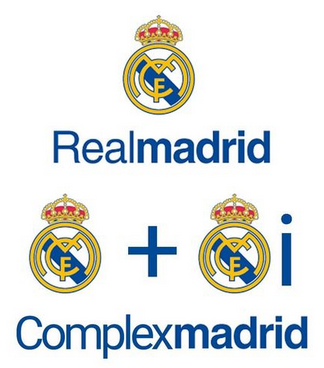
Complex Madrid
Μία εικασία που έγινε θεώρημα
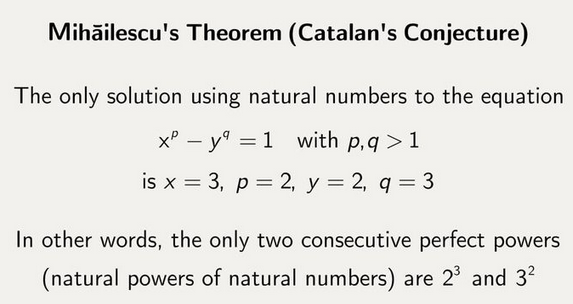
Εικασία Catalan – Θεώρημα Mihailescu
Το μόνο ζεύγος διαδοχικών φυσικών αριθμών που γράφονται ως τέλειες δυνάμεις είναι το (8,9)
https://www.facebook.com/groups/1664980577160670/permalink/3185201775138535
Θεώρημα Poncelet-Steiner
Γεωμετρικές κατασκευές με κανόνα και «σκουριασμένο» διαβήτη !
https://en.wikipedia.org/wiki/Poncelet%E2%80%93Steiner_theorem
Κατασκευή Παράλληλης από σημείο εκτός ευθείες προς δοσμένη ευθεία ΑΒ με δοσμένο μέσο του ΑΒ
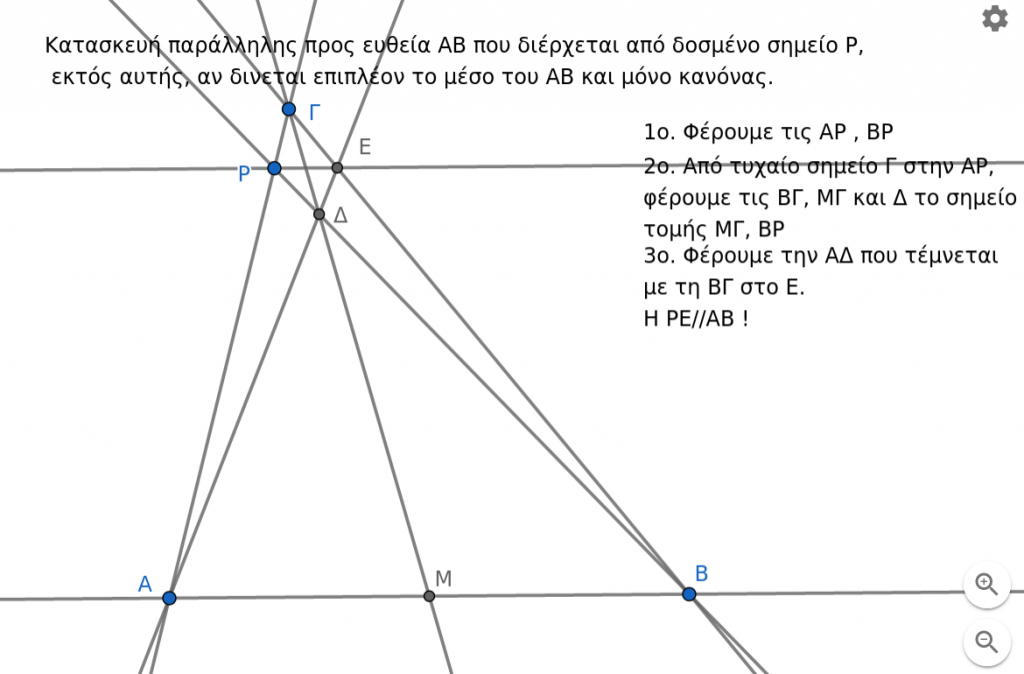
Δείτε την κατασκευή στο παρακάτω gifακι:
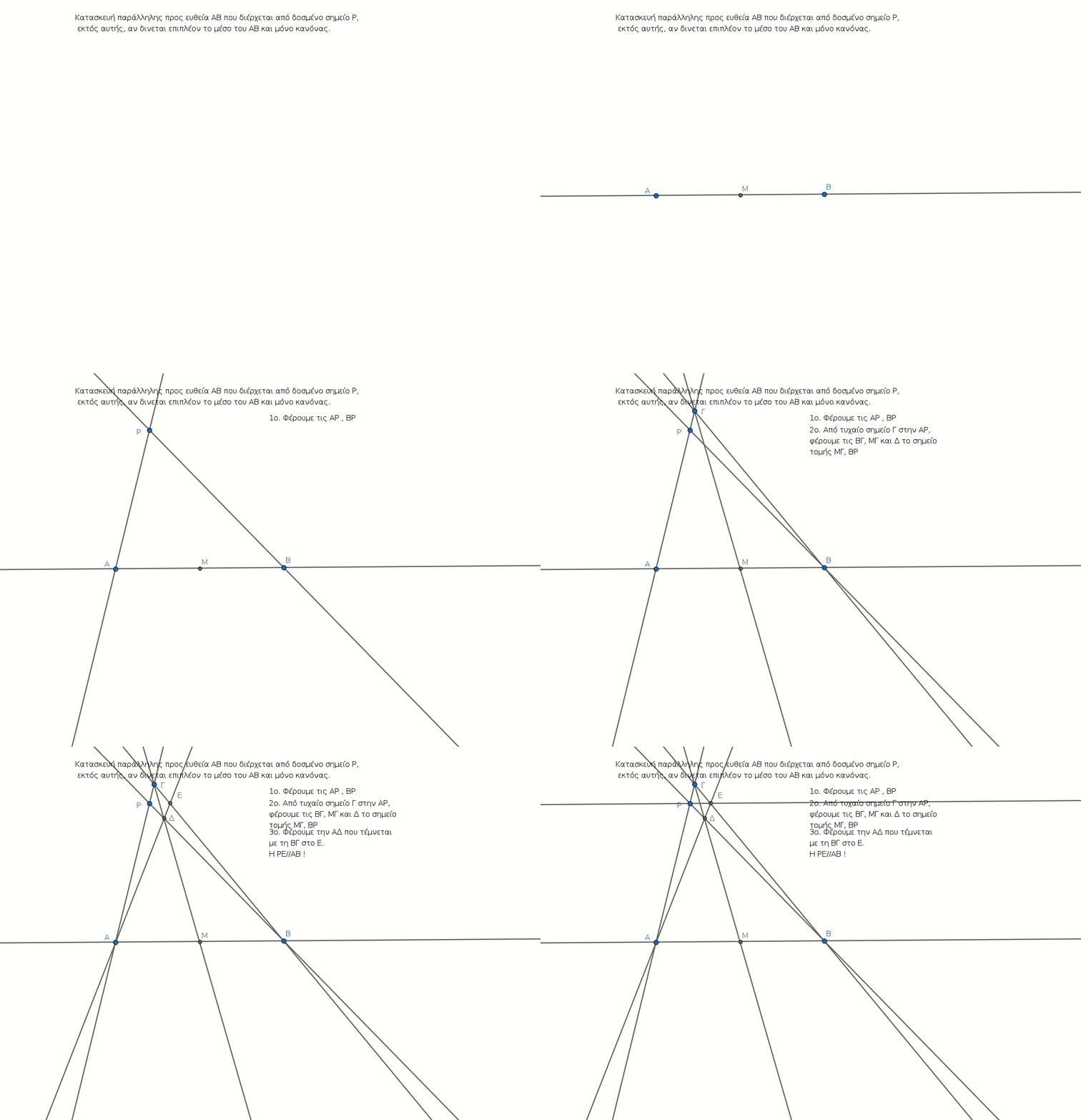
https://www.geogebra.org/geometry/mxvcjzuw?embed
Κατασκευή κάθετης προς ευθεία από δοσμένο σημείο.
https://www.geogebra.org/classic/zzquanan
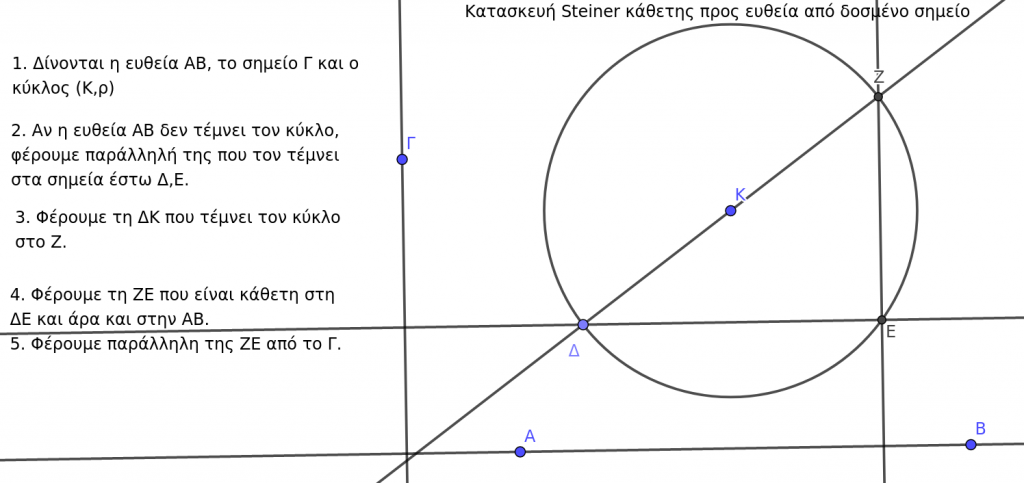
Κατασκευή steiner ευθυγράμμου τμήματος σε δοσμένη ευθεία, με το μέσο του
https://www.geogebra.org/classic/becnhq6t
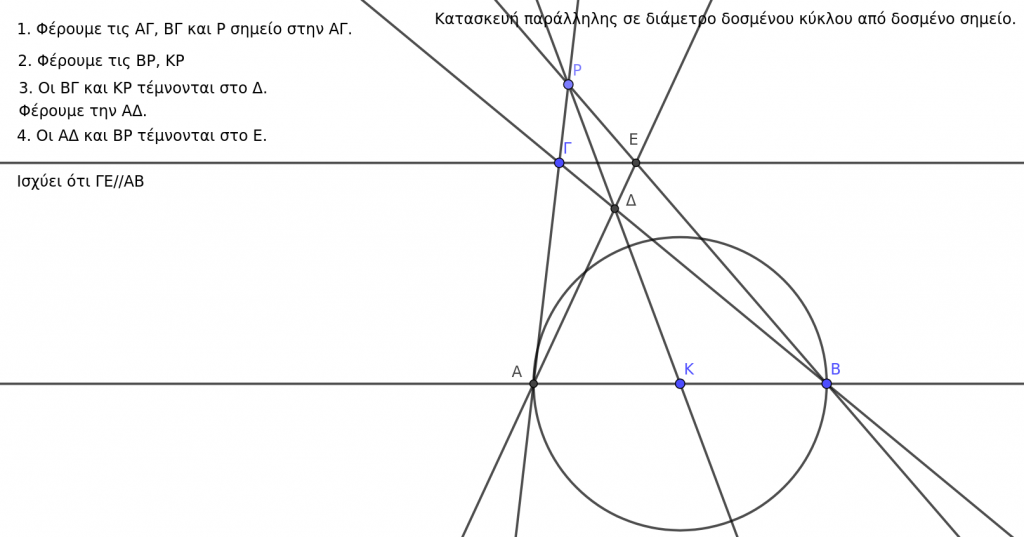
Κατασκευή Steiner παράλληλης από δοσμένο σημείο σε διάμετρο δοσμένου κύκλου.
https://www.geogebra.org/classic/mftdyqv3
The Poncelet-Steiner theorem says
Everything you can construct with a straightedge and a compass you can construct by the straightedge alone, provided you are given a circle and its center.
Motivated by Mascheroni’s result ↑ J.V.Poncelet conjectured this results in 1812��[1]��and it was proved by J.Steiner [2]��in 1833.
It can be shown that the constructions cannot be done by straightedge alone [3] . By the straightedge alone only the so called linear constructions can be done. For instance, using the straightedge alone, without a circle given, is not sufficient to construct square roots. Even simpler constructions as to half a straight line segment are impossible by the straightedge alone. Another example is the result known as Steiner’s theorem:
Steiner’s Theorem: It is impossible to find the center of a given circle with the straightedge alone.
The basic idea of the following proof goes back to Hilbert. If such a construction would be possible, then it would be preserved by projective transformations.��This due to the basic properties of projective transformation which preserve lines, objects constructible by the straightedge. On the other hand, the circle as a conic section is transformed to a conic section in general.��Even worse, the conjugate diameters 1 of a conic section pre-image may not be transformed to the conjugate diameters of the image. Consequently, the center of circle is not projected to the center of the image.
Άρθρο Poncelet-Steiner
33-Poncelet-Steiner-TheoremΕπιπλέον πηγές
Χρόνος…

2022 ευχές…και ακόμα περισσότερες προσπάθειες
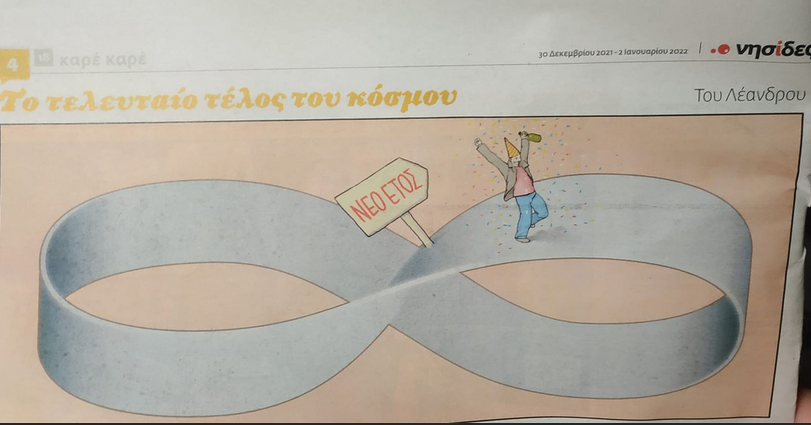
Το τέλος του κόσμου…
Το \(0^0\)
What is \(0^0\) , and who decides, and why does it matter? Definitions in mathematics.
Posted on November 1, 2018 by Art Duval
By Art Duval, Contributing Editor, University of Texas at El Paso
How is 00 defined? On one hand, we say x0=1 for all positive x; on the other hand, we say 0y=0 for all positive y. The French language has the Académie française to decide its arcane details. There is no equivalent for mathematics, so there is no one deciding once and for all what 00
equals, or if it even equals anything at all. But that doesn’t matter. While some definitions are so well-established (e.g., “polynomial”, “circle”, “prime number”, etc.) that altering them only causes confusion, in many situations we can define terms as we please, as long as we are clear and consistent.
Don’t get me wrong; the notion of mathematics as proceeding in a never-ending sequence of “definition-theorem-proof” is essential to our understanding of it, and to its rigorous foundations. My mathematical experience has trained me to ask, “What are the definitions?” before answering questions in (and sometimes out of) mathematics. Yet, while we tell students that the definition needs to come before the proof of the theorem, what students apparently hear is that the definition needs to come before the idea, as opposed to the definition coming from the idea.
Why definitions?
What is a definition anyway? Or rather, what gets defined? We could make a special name for the function that maps x to 5×17–29×2+42, but we don’t. On the other hand, we give the name “sine function” to sin(x), the ratio of the length of the side opposite an angle with measure x to the length of the hypotenuse of a right triangle. We give a name to the sine function, even though it takes much longer to describe than 5×17–29×2+42; in fact, we give it a name in part precisely because it takes longer to describe. If we need to refer to 5×17–29×2+42
, it’s not that hard, but we do not want to have to write down that definition of sine every time we use it in a statement or problem. We give definitions to ideas for two related reasons:
Brevity: It’s clearly easier to write “sin(x)
” instead of the huge sentence above. Further, packing this idea into a single word helps make it easier to chunk ideas in an even longer statement, such as a trigonometric identity.
Repetition: If we have to use the same idea more than once, then giving it a compact name increases the efficiency described above that much more. Sometimes an idea repeats just locally, within a single argument or discussion, and then we might temporarily give it a name; for instance when finding the maximum value xe−x, we would write f(x)=xe−x, so we could then write 0=f′(x), but we are only using f this way in this one problem. On the other hand, the ideas that show up over and over again, in many different contexts, such as sin(x)
or “vector space”, get names that stick.
This begs the question, “Why do certain ideas, or combinations of conditions, repeat?” Consider “vector space”. The idea of Rn
is clear enough, but of all its properties, why focus on the simple rules satisfied by vector addition and scalar multiplication?

Defining terms in mathematics involves more choices than students think.
First, because several additional examples have been found that satisfy these rules, such as the vector space of continuous functions, the vector space of polynomials, and the vector space of polynomials of degree at most 5. Second, because once the key properties that make up the definition are identified, we may find that the proofs only depend on those key properties: The Fundamental Theorem of Linear Algebra, for instance, is true for arbitrary finite-dimensional vector spaces, so we don’t need a separate proof for Rn
, for polynomials of degree at most 5, etc. (Purists may argue that all finite-dimensional vector spaces of the same dimension are isomorphic, but this isomorphism is defined in terms of vector addition and scalar multiplication, just reinforcing the significance of those operations.)
Choices
But there are often still choices to be made. Must a vector space include the zero vector, or could it be empty? (Is the empty set a vector space)? For that matter, since vectors are often described as being determined by “a direction and a magnitude” and the zero vector has no direction, is the zero vector even a vector? The answers to these questions are no and yes, respectively, but why? The zero vector is a vector, because it is so helpful for a vector space to be a group under addition, which requires an identity element. (I know — this only takes us back to why are groups defined the way they are. Let’s just take this as a piece of evidence for why groups are an important definition.)
As for the empty vector space, there’s nothing inherently wrong with it, except perhaps for the need for a zero vector as discussed above. (This also takes us back to why groups are not allowed to be empty. Let’s stick to vector spaces for now.) But how would we define the dimension of an empty vector space? How would we define the sum of the empty vector space with another vector space? And then, even if we do make those definitions, how do we reconcile them with this identity?:
dim(A+B)= dimA + dimB − dim(A∩B)
This example shows that, even though we cannot write the proof of a theorem until all the relevant definitions are stated, we do often look ahead at the theorem before settling on the fine points of the definition. At research-level mathematics, we might even modify our definitions substantially to make our theorems stronger, or to deal with potential counterexamples. (For more details on this, read Imre Lakatos’ classic Proofs and Refutations [1].) I will stick to smaller cases where we adjust definitions mostly just to make the theorems easier to state.
More examples
Why is 1 considered to be neither prime nor composite? When you first learn this, it may seem silly. The definition of prime is so simple and elegant — an integer n is prime if its only factors are 1 and n — and 1 seems to fit that definition just fine. Why make an exception? The answer lies in the Fundamental Theorem of Arithmetic, that every integer has a unique factorization. Well, except of course that we could change the order of the factors around; for instance, it makes sense to consider 17×23 to be the same factorization as 23×17. And also we need to leave out any factors of 1, otherwise we might consider 17×23,1×17×23,1×1×17×23
, … to all be different factorizations. If we take a little extra effort at the definition, and rule out 1 as a prime number, then the theorem becomes more elegant to state.
Is a square also a rectangle? In other words, should we define rectangle to include the possibility that the rectangle is a square, or exclude that possibility? When children first learn about shapes, it’s easier to simply categorize shapes, so a shape could be either a rectangle or a square, but not both. But when writing a careful definition of rectangle, it takes more work to exclude the case of a square than to simply allow it. Similarly, theorems about rectangles are easier to state if we don’t have to exclude the special cases where the rectangle happens to be a square: “Two different diameters of a circle are the diagonals of a rectangle” is more elegant than “Two different diameters of a circle are the diagonals of a rectangle, unless the diameters are perpendicular, in which case they are the diagonals of a square.”
Is 0 is a natural number? It doesn’t really matter; just pick an answer, be consistent, and move on. It’s even better if we can use non-ambiguous language instead, such as “positive integers” or “non-negative integers.” To be sure, mathematics is picky, but let’s not be picky about the wrong things.
Finally, what about 00? If you just look at limits, you’d be ready to declare that this expression is undefined (the limit of xy as x and y approach 0 is not defined, even just considering x≥0 and y≥0). And that’s fine. But in combinatorics, where I work, setting 00=1 makes the binomial theorem ((x+y)n=∑(nk)xkyn−k) work in more cases (for instance when y=0). And so we simply declare 00=1
, at least in combinatorics, even though it might remain undefined in other settings.
(See here for a list of other “ambiguities” in mathematics definitions.)
In each of these examples, there is a human choice about how to exactly state the definition. This is a great freedom. But, to alter a popular phrase, with great freedom comes great responsibility. If you declare 00 is a value other than 1, now you are limiting, not expanding, the applicability of the binomial theorem. And if you want to declare that 10
has any numerical value, you will have to sacrifice at least some of the field axioms in your new number system.
In the classroom
The issues that arise with developing precise mathematical definitions is well-known to mathematicians, but we generally don’t share it with our students enough. If we stop hiding this story from our students, then they will see that mathematics is a human endeavor, and that mathematical subjects are not handed down to us from on high. This can be one factor in convincing students that mathematics, even advanced mathematics, is something they can do, that it is not just reserved for other people. And even students who already “get it” will not be turned off — we should not abandon definition-theorem-proof, we can just pay more attention to sharing why each of our definitions is written the way it is. If students know where a definition comes from, what motivated it, and why we made the choices we did, they may have a better chance of making sense of the idea instead of memorizing the string of words or symbols. (See also my earlier blog post, A Call for More Context.)
An anecdote that Keith Devlin tells, near the end of a blog post about mathematical thinking, illustrates the power of crafting the right definition. To summarize much too briefly, his task was to “look at ways that reasoning and decision making are influenced by the context in which the data arises” in a national security setting. His first step was to “write down as precise a mathematical definition as possible of what a context is.” When he presented his work to government bigwigs, they never got past his first slide, with that definition, because the entire room spent the whole time discussing that one definition; later he was told “That one slide justified having you on the project.”
We might not have the luxury of spending an entire hour discussing a single definition, but we can still let students in on the secret that the definitions are up to us, and that writing them well can make all the difference.
References
[1] Lakatos, Imre. Proofs and refutations. The logic of mathematical discovery. Edited by John Worrall and Elie Zahar. Cambridge University Press, Cambridge-New York-Melbourne, 1976.
Ξενόγλωσση βιβλιογραφία Μαθηματικών διαγωνισμών
Προτεινόμενα βιβλία για Μαθηματικές Ολυμπιάδες
τα περισσότερα από αυτά είναι σε προχωρημένο επίπεδο. Για όσους τώρα ξεκινούν μπορούν για αρχή να κοιτάξουν την υπάρχουσα Ελληνική βιβλιογραφία. International Mathematical Olympiad D. Djukic, V. Jankovic, I. Matic, N. Petrovic : The IMO Compendium 1959-2009, Springer, 2011. M. Becheanu : International Mathematical Olympiads 1959-2000. Problems. Solutions. Results, Academic Distribution Center, Freeland, USA, 2001.
I. Reiman, J. Pataki, A. Stipsitz : International Mathematical Olympiad: 1959–1999 , Anthem Press, London, 2002. I. Cuculescu : International Mathematical Olympiads for Students (in Romanian), Editura Tehnica, Bucharest, 1984. A.A. Fomin, G.M. Kuznetsova : International Mathematical Olympiads (in Russian), Drofa, Moscow, 1998. M. Aassila : 300 Defis Mathematiques (in French), Ellipses, Paris, 2001. M.S. Klamkin : International Mathematical Olympiads 1979–1986, MAA, Washington, D.C., 1988. S.L. Greitzer : International Mathematical Olympiads 1959-1977, MAA, Washington, D.C., 1978. V. Jankovic, V. Micic : IX and XIX International Mathematical Olympiads, MS of Serbia, Belgrade, 1997. M.S. Klamkin : International Mathematical Olympiads 1979–1985 and Forty Supplementary Problems , MAA, Washington, D.C., 1986. E.A. Morozova, I.S. Petrakov, V.A. Skvortsov : International Mathematical Olympiads (in Russian), Prosveshchenie, Moscow, 1976. M. Asic et al. : International Mathematical Olympiads (in Serbian) , MS of Serbia, Belgrade, 1986. V. Jankovic, Z. Kadelburg, P. Mladenovic : International and Balkan Mathematical Olympiads 1984–1995 (in Serbian), MS of Serbia, Belgrade, 1996. Other Mathematical Olympiads T. Andreescu, K. Kedlaya, P. Zeitz : Mathematical Olympiads 1995-1996, Problems and Solutions from Around the World, AMC, 1997. T. Andreescu, Z. Feng : Mathematical Olympiads 2000-2001, Problems and Solutions from Around the World, MAA, 2003. A. Gardiner : The Mathematical Olympiad Handbook, Oxford, 1997. A. Liu : Hungarian Problem Book III, MAA, 2001. A.M. Slinko : USSR Mathematical Olympiads 1989–1992, AMT, Canberra, 1997. A. Liu : Chinese Mathematical Competitions and Olympiads 1981-1993, AMT, Canberra, 1998. I. Tomescu et al. : Balkan Mathematical Olympiads 1984-1994 (in Romanian), GIL Publishing House, Zalau, 1996. K.S. Kedlaya, B. Poonen, R. Vakil : The William Lowell Putnam Mathematical Competition 1985-2000 Problems, Solutions and Commentary, MAA, 2002. D. Fomin, A. Kirichenko : Leningrad Mathematical Olympiads 1987-1991, MathPro Press, 1994. M.E. Kuczma : 144 Problems of the Austrian-Polish Mathematics Competition 1978–1993, The Academic Distribution Center, Freeland, Maryland, 1994. T. Andreescu, Z. Feng : Mathematical Olympiads 1999-2000, Problems and Solutions from Around the World, MAA, 2002. Lausch, Bosch Giral : Asian Pacific Mathematics Olympiads 1989–2000, AMT, Canberra, 1994. Kurshak, Hajos, Neukomm, Suranyi : Hungarian Problem Book II, MAA, 1967. Kurshak, Hajos, Neukomm, Suranyi : Hungarian Problem Book I, MAA, 1967. M.S. Klamkin : USA Mathematical Olympiads 1972–1986, MAA, Washington, D.C., 1988. T. Andreescu, K. Kedlaya : Mathematical Olympiads 1997-1998, Problems and Solutions from Around the World, AMC, 1999. T. Andreescu, Z. Feng : Mathematical Olympiads 1998-1999, Problems and Solutions from Around the World, MAA, 2000. Lausch, Taylor : Australian Mathematical Olympiads 1979–1995, AMT, Canberra, 1997. Peter J. Taylor : International Mathematics Tournament of the Towns, Book 1: 1980-1984, AMT Publishing, 1993. T. Andreescu, K. Kedlaya : Mathematical Olympiads 1996-1997, Problems and Solutions from Around the World, AMC, 1998. Peter J. Taylor : International Mathematics Tournament of the Towns, Book 3: 1989-1993, AMT Publishing, 1994. Andrei M. Storozhev : International Mathematics Tournament of the Towns, Book 5: 1997-2002, AMT Publishing, 2006. Peter J. Taylor : International Mathematics Tournament of the Towns, Book 2: 1984-1989, AMT Publishing, 2003. L. Hahn : New Mexico Mathematics Contest Problem Book, University of New Mexico Press, 2005. G.L. Alexanderson, L.F. Klosinski, L.C. Larson : The William Lowell Putnam Mathematical Competition, Problems and Solutions: 1965-1984, MAA, 1985. Peter J. Taylor, Andrei M. Storozhev : International Mathematics Tournament of the Towns, Book 4: 1993-1997, AMT Publishing, 1998. A.M. Gleason, R.E. Greenwood, L.M. Kelly : The William Lowell Putnam Mathematical Competition, Problems and Solutions: 1938-1964, MAA, 1980. Other Problem Solving Books P. Zeitz : The Art and Craft of Problem Solving, Wiley; International Student edition, 2006. T. Andreescu, D. Andrica : 360 Problems for Mathematical Contests, GIL Publishing House, Zalau, 2003. L. Moisotte : 1850 exercices de mathemathique , Bordas, Paris, 1978. A. Engel : Problem Solving Strategies, Springer-Verlag, 1999. C.R. Pranesachar, S.A. Shailesh, B.J. Venkatachala, C.S. Yogananda : Mathematical Challenges from Olympiads, Interline Publishing Pvt. Ltd., Bangalore, 1995. A.M. Yaglom, I.M. Yaglom : Challenging Mathematical Problems with Elementary Solutions, Dover Publications, 1987. M. Aigner, G.M. Ziegler : Proofs from THE BOOK, Springer-Verlag; 3rd edition, 2003. R. Gelca, T. Andreescu : Putnam and Beyond, Springer 2007. T. Andreescu, B. Enescu : Mathematical Olympiad Treasures, Birkhauser, Boston, 2003. Z. Stankova, T. Rike : A Decade of the Berkeley Math Circle , American Mathematical Society, 2008 E. Lozansky, C. Rousseau : Winning Solutions, Springer-Verlag, New York, 1996. R.L. Graham, D.E. Knuth, O. Patashnik : Concrete Mathematics, 2nd Edition, Addison-Wesley, 1989. T. Andreescu, R. Gelca : Mathematical Olympiad Challenges, Birkhauser, Boston, 2000. R. Vakil : A Mathematical Mosaic: Patterns and Problem Solving (2nd. ed.), M.A.A., 2007 G. Polya : How to Solve It: A New Aspect of Mathematical Method, Princeton University Press R. Honsberger : In Polya \?s Footsteps: Misscelaneous Problems and Essays, M.A.A., 1997 R. Honsberger : From Erdos to Kiev: Problems of Olympiad Caliber, M.A.A., 1996 E.J. Barbeau, M.S. Klamkin. W.O.J. Moser : Five Hundred Mathematical Challenges , MAA, 1995. T. Andreescu, G. Dospinescu : Problems from the Book, XYZ Press, 2008. L.C. Larson : Problem Solving Through Problems, Springer-Verlag, 1983. Algebra, Analysis, and Inequalities P.K. Hung: Secrets in Inequalities, GIL Publishing House, 2007 T. Andreescu, V. Cartoaje, G. Dospinescu, M. Lascu : Old and New Inequalities , GIL Publishing House, 2004. E.J. Barbeau : Polynomials , Springer-Verlag, 2003. N.D. Kazarinoff : Geometric Inequalities , MAA, 1975. C.G. Small : Functional Equations and How to Solve Them, Springer, 2006 A.S. Posamentier, C.T. Salkind : Challenging Problems in Algebra, Dover Books in Mathematics, 1996. T. Andreescu, D. Andrica : Complex Numbers from A to … Z, Birkhauser, Boston, 2005. P.S. Bullen, D.S. Mitrinovic , M. Vasic : Means and Their Inequalities, Springer-Verlag, 1989. M. Arsenovic, V. Dragovic : Functional Equations (in Serbian) , MS of Serbia, Belgrade, 1999. Z. Cvetkovski : Inequalities – Theorems, Techniques and Selected Problems , Springer, 2012. D.S. Mitrinovic, J.E. Pecaric, V. Volenec : Recent Advances in Geometric Inequalities, Kluwer Academic Publishers, 1989. J. Hardy, J.E. Littlewood, G. Polya : Inequalities, Cambridge University Press; 2nd edition, 1998. D.S. Mitrinovic , J. Pecaric, A.M Fink : Classical and New Inequalities in Analysis, Springer-Verlag, 1992. G.H. Herman, R. Kucera, K. Dilcher : Equations and Inequalities, Springer, 2000 Z. Kadelburg, D. Djukic, M. Lukic, I. Matic : Inequalities (in Serbian), MS of Serbia, Belgrade, 2003. Geometry and Trigonometry P.S. Modenov : Problems in Geometry, MIR, Moscow, 1981. H.S.M. Coxeter : Introduction to Geometry , John Willey and Sons, New York, 1969 T. Andreescu, Z. Feng : 103 Trigonometry Problems: From the Training of the USA IMO Team, Birkhauser Boston, 2004. I.M. Yaglom : Geometric Transformations, Vol. II, MAA, 1968. A.P. Kiselev (author), A. Givental (editor) : Kiselev\?s Geometry / Book I. Planimetry (Hardcover) , Sumizdat, 2006 P.S. Modenov, A.S. Parhomenko : Geometric Transformations, Academic Press, New York, 1965. I.M. Yaglom : Geometric Transformations, Vol. I, MAA, 1962 N. Altshiller-Court : College Geometry: An Introduction to the Modern Geometry of the Triangle and the Circle, Dover Publications, 2007 V.V. Prasolov, V.M. Tikhomirov : Geometry, American Mathematical Society, 2001. C.J. Bradley : Challenges in Geometry : for Mathematical Olympians Past and Present, Oxford University Press, 2005. L. Hahn : Complex Numbers and Geometry, New York, 1960. I.M. Yaglom : Geometric Transformations, Vol. III, MAA, 1973. A.S. Posamentier, C.T. Salkind : Challenging Problems in Geometry, Dover Publications, 1996. I.F. Sharygin : Problems in Plane Geometry, Imported Pubn, 1988. T. Andreescu, O. Mushkarov, L. Stoyanov : Geometric Problems on Maxima and Minima, Birkhauser Boston, 2005. H.S.M. Coxeter, S.L. Greitzer : Geometry Revisited , Random House, New York, 1967 Number Theory M.Th. Rassias : Problem-Solving and Selected Topics in Number Theory : In the Spirit of the Mathematical Olympiads Foreword by Preda Mihailescu, Springer, New York, 2011. I. Nagell : Introduction to Number Theory, John Wiley and Sons, Inc., New York, Stockholm, 1951. W. Sierpinski : 250 Problems in Elementary Number Theory, American Elsevier Publishing Company, Inc., New York, PWN, Warsaw, 1970. E.J. Barbeau : Pell?s Equation , Springer-Verlag, 2003. W. Sierpinski : Elementary Theory of Numbers, Polski Academic Nauk, Warsaw, 1964. A. Baker : A Concise Introduction to the Theory of Numbers , Cambridge University Press, Cambridge, 1984. I.M. Vinogradov : The Method of Trigonometrical Sums in the Theory of Numbers, Dover Books in Mathematics, 2004. I.M. Vinogradov : Elements of Number Theory, Dover Publications, 2003. T. Andreescu, D. Andrica : An Introduction to the Diophantine Equations, GIL Publishing House, Zalau, 2002. R.K. Guy : Unsolved Problems in Number Theory, Springer-Verlag, 3rd edition, 2004. L.J. Mordell : Diophantine Equations, Academic Press, London and New York, 1969. J. Tattersall : Elementary Number Theory in Nine Chapters (2nd. ed.), Cambridge University Press, 2005. I. Niven, H.S. Zuckerman, H.L. Montgomery : An Introduction to the Theory of Numbers , John Wiley and Sons, Inc., 1991. V. Micic, Z. Kadelburg, D. Djukic : Introduction to Number Theory (in Serbian), 4th edition, MS of Serbia, Belgrade, 2004. G.H. Hardy, E.M. Wright : An Introduction to the Theory of Numbers, Oxford University Press; 5th edition, 1980. T. Andreescu, D. Andrica, Z. Feng : 104 Number Theory Problems, Birkhauser, Boston 2006 Combinatorics, Graph Theory, and Game Theory T. Andreescu, Z. Feng : 102 Combinatorial Problems, Birkhauser Boston, 2002. S. Lando : Lectures on Generating Functions, A.M.S., 2003. I. Tomescu, R.A. Melter : Problems in Combinatorics and Graph Theory, John Wiley and Sons, 1985. C. Chuan-Chong, K. Khee-Meng : Principles and Techiques in Combinatorics, World Scientific Publishing Company, 1992. H.S. Wilf : Generatingfunctionology , Academic Press, Inc.; 3rd edition, 2006. R.Brualdi : Introductory Combinatorics (4th ed.), Prentice-Hall, 2004. E.L. Berlekamp, J.H. Conway, R.K. Guy : Winning Ways for Your Mathematical Plays (Vol. 1), AK Peters, Ltd., 2nd edition, 2001. D. Stevanovic, M. Milosevic, V. Baltic : Discrete Mathematics: Problem Book in Elementary Combinatorics and Graph Theory (in Serbian), MS of Serbia, Belgrade, 2004. T. Andreescu, Z. Feng : A Path to Combinatorics for Undergraduates: Counting Strategies, Birkhauser Boston, 2003. P. Mladenovic : Combinatorics (in Serbian), 3rd edition, MS of Serbia, Belgrade, 2001. R.P. Stanley : Enumerative Combinatorics, Volumes 1 and 2, Cambridge University Press; New Ed edition, 2001. E.L. Berlekamp, J.H. Conway, R.K. Guy : Winning Ways for Your Mathematical Plays (Vol. 4), AK Peters, Ltd., 2nd edition, 2004. E.L. Berlekamp, J.H. Conway, R.K. Guy : Winning Ways for Your Mathematical Plays (Vol. 3), AK Peters, Ltd., 2nd edition, 2003. J.H. van Lint, R.M. Wilson : A Course in Combinatorics, second edition, Cambridge University Press, 2001. E.L. Berlekamp, J.H. Conway, R.K. Guy : Winning Ways for Your Mathematical Plays (Vol. 2), AK Peters, Ltd., 2nd edition, 2003. Πηγή: imomath
